
📋 Article outline
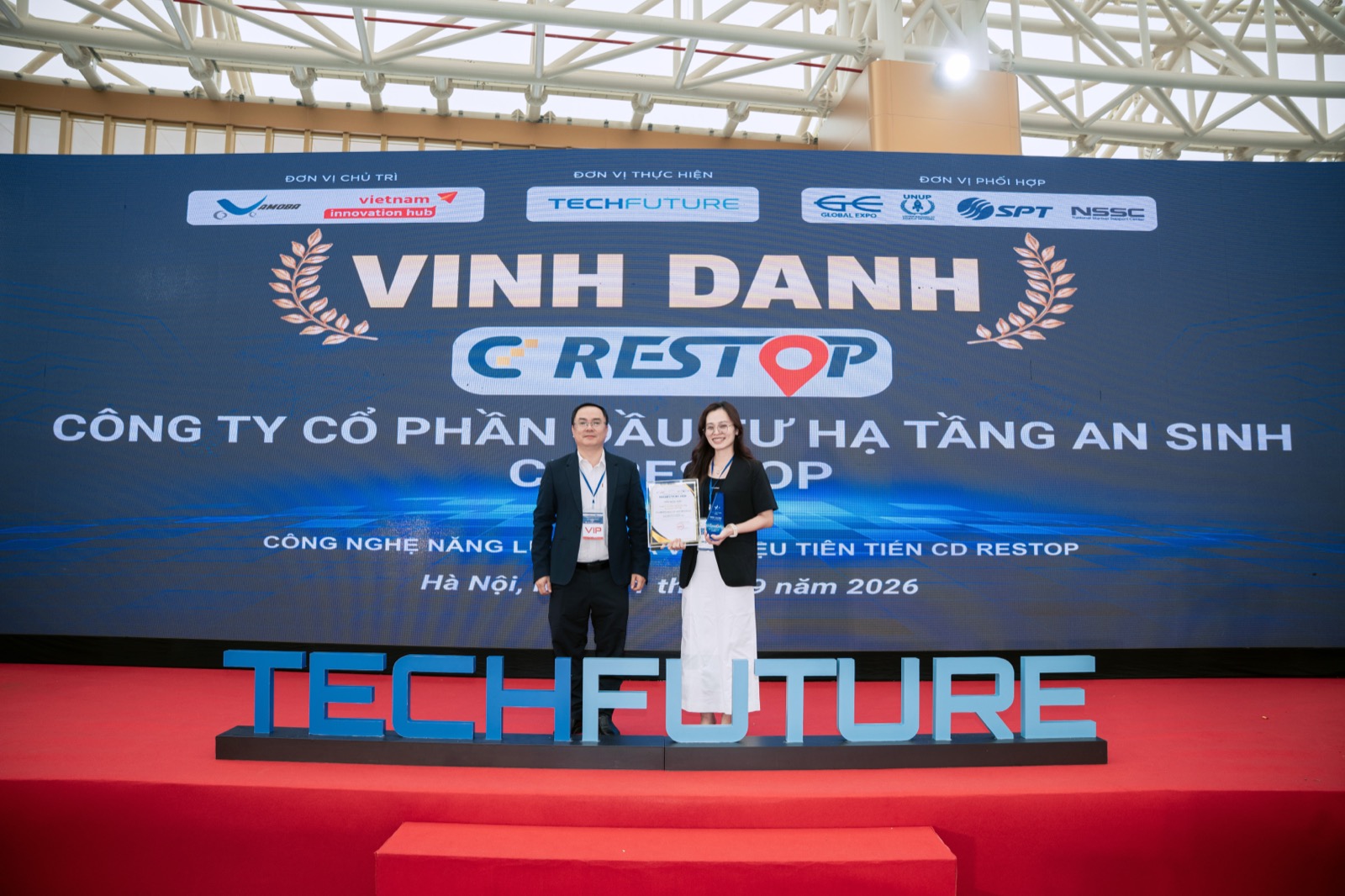
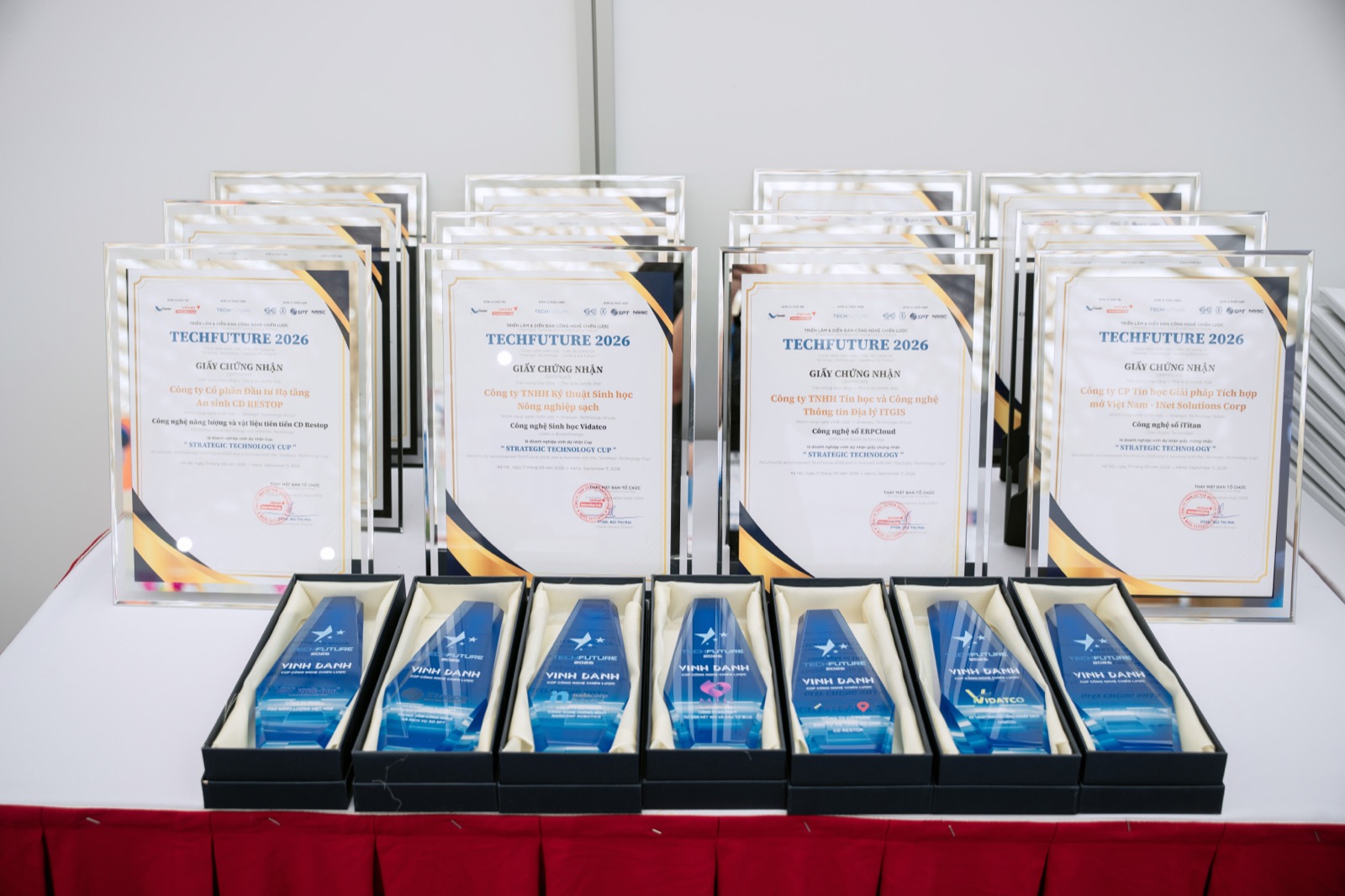
Hanoi, 11 September 2026 — Today, at Hall 4, Trung tâm Triển lãm Việt Nam (VEC), Cầu Tứ Liên Street, Đông Anh, Công ty Cổ phần Đầu tư Hạ tầng An sinh CD Restop was among the businesses honoured and awarded the Cúp Công nghệ Chiến lược (Strategic Technology Cup) of TechFuture 2026, in the Energy Technology and Advanced Materials category.
TechFuture 2026 is the Strategic Technology Exhibition and Forum, themed "Strategic Technology — Leading the Future", chaired by VAMOBA and Vietnam Innovation Hub and organised by TechFuture, in coordination with Global Expo, UNUP, Tập đoàn SPT and NSSC.
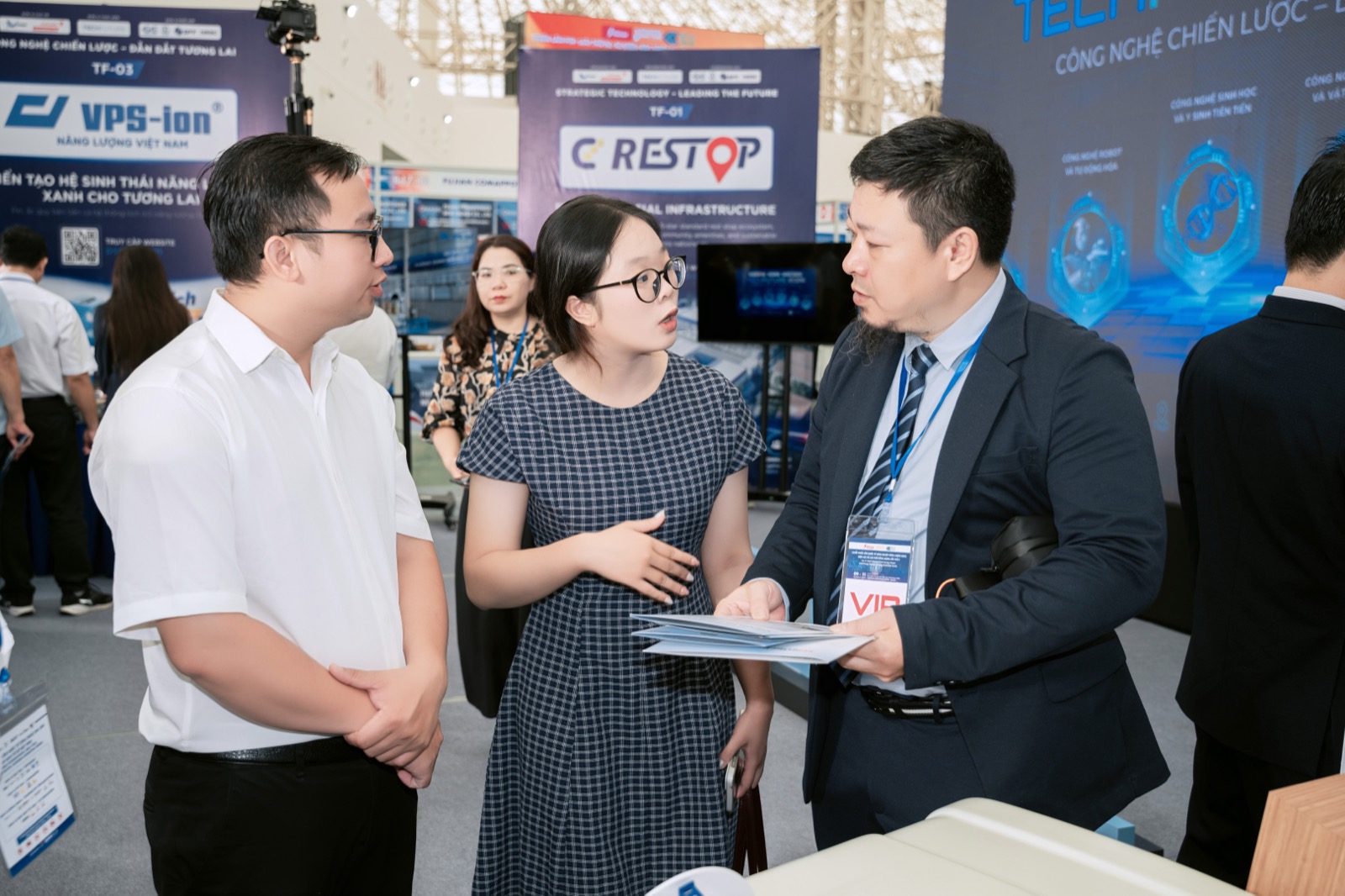
Across 10 and 11/09, CD Restop took part in two roles at once: as an entrant in the strategic technology pitching session, and as an exhibitor with booth code TF-01. The entry was titled "The social-welfare rest stop — infrastructure for people on the road".
What CD Restop brought to the stage was not a single piece of technology but a question: where along the journey does technology have to sit in order to reach working people.
The problem taken to the stage: the policy exists, the infrastructure does not
The pitch opened by framing the issue around three specific groups. Long-haul and coach drivers stop informally by the roadside, with no rest area that meets standards, no toilets and no security at night. Ride-hailing and delivery drivers have nowhere to rest mid-shift, and no charging point that is both close and safe once they switch to electric vehicles. Informal workers and residents along the corridors lack public services, policy information and basic amenities anywhere near where they earn their living.
Meanwhile the legal framework has opened the way: Road Law 35/2024 requires rest stops to have charging systems; QCVN 43:2024 raises the technical standard for rest stops; Directive 20/CT-TTg sets a roadmap for restricting petrol and diesel vehicles in urban areas; and new laws on social insurance, trade unions and employment extend the welfare net to informal workers.
The gap lies in between: the regulations now mandate charging stations and rest stops that meet standards, yet no model has standardised all three layers at once — the built facility, the energy system and the welfare services — in a form that can be replicated at scale.
The "Five Musts" commitment standard
The answer CD Restop presented is that every rest stop is run as a welfare institution for its locality, not as a charging station with a few seats added. It comes with the Five Musts standard, applied at every site:
- MUST HAVE clean energy — charging points and on-site solar power.
- MUST HAVE meals and essential goods — at welfare prices, publicly listed.
- MUST HAVE safe digital financial services — payments and digital utilities on site.
- MUST HAVE community life — regular cultural and community activities.
- MUST HAVE welfare for people on the road — rest areas, free toilets built to standard, and a policy information corner.
The mechanism that funds the welfare components is called "self-sustaining welfare": commercial revenue at each site — food and beverage, retail, charging and services — is set aside to maintain the welfare side. The company invests and is accountable for operations; the authorities and mass organisations shape and supervise; the scheme uses no state budget.
Three platforms that turn a rest stop into workable infrastructure
The core technology section of the pitch set out three platforms, each tied to a concrete change in a user's day.
- Energy management — real-time monitoring of the step-down substation, solar array, storage system and every charging point; load dispatch and optimisation of self-consumed power; technical alerts routed to whoever is actually on duty. What the user sees: the power does not drop mid-charge, and the rest stop keeps running when the grid is weak.
- Surveillance cameras — round-the-clock security over the overnight parking area and the service zone, tied to shift rosters and checklists, so every incident has a named owner, a timestamp and footage. At unstaffed partner-linked sites, this is the site's "person on duty".
- Metering and reconciliation — a dedicated meter at each site rather than a connection shared behind a partner's meter; output metering for reconciliation; two-way revenue reconciliation through a data link with the charging platform. In practice: the listed price is the real price, and all parties look at the same number.
The three platforms share one foundation: they run on web and mobile, with permissions mapped to the organisation chart, audit logs, separate test and production environments, and data stored in Vietnam.
One set of standards, four site tiers
To replicate quickly without losing control of quality, the network is standardised into four site tiers before any individual site is designed. The tier determines the scale of investment, the electrical configuration and the service mix.
- Complex, 3,000 to 5,000 m² — located at ports, transport hubs and key national interchanges.
- Tier A, 1,500 to 3,000 m² — regional transport hubs, large charging clusters with a service complex.
- Tier B, 500 to 1,500 m² — urban gateways and major interchanges, focused on fast charging.
- Tier C, under 500 m² — linked sites placed on a partner's existing premises, operating unstaffed.
Tier C is the network's cheapest replicable unit: CD Restop installs the infrastructure on a partner's existing premises, with its own management perimeter, its own meter, and every item removable and relocatable. It is a way to expand coverage fast without buying land. The network is targeting 500 rest stops and 14,000 satellite charging points across 34 provinces and cities, with a target spacing of 60 to 100 km between sites.
A note on sources: the areas per tier and the spacing between sites are parameters of the design standard presented at the pitching session. The figures published in the documents signed on 09/09 are 500 rest stops, 14,000 satellite charging points, 34 provinces and cities, and four site tiers.
The evidence: four documents signed the day before
The pitch devoted a section to evidence. On 09/09/2026, immediately before TechFuture opened, four documents — one strategic cooperation agreement and three memoranda of understanding — were signed in Ho Chi Minh City between Tập đoàn SPT, CD Restop, DTH Holdings, Coro Energy and partners, grouped into three chapters: the Scharge Platform, the Network and the Digital City. CD Restop was a signatory to two of the documents and a witness to the other two. Details were published in the news item of 09/09.
An invitation: six technology areas seeking partners
The pitch closed with an invitation. The network already has premises, power, an operating platform and a real user base; what CD Restop is looking for are solutions that plug into it. Six technology areas were named:
- Machine vision and AI cameras — traffic counting, licence plate recognition, on-site safety alerts.
- Battery swapping and next-generation charging — EV battery swap modules, ultra-fast charging, battery management.
- IoT sensors and automation — unstaffed site operation, environmental and electrical safety monitoring.
- Payments, digital identity and wallets — a one-tap experience for drivers and residents around each site.
- Public services and digital utilities — digital citizen counters, community bulletins, local data connections.
- Smart vending — cabinets of essential goods at welfare prices, a mandatory item at linked sites.
The proposed way of working together runs in three steps: pilot at a site already in operation, standardise into the design set for each tier, then replicate across the network in 34 provinces and cities.
Technology companies interested can get in touch at hi@cdrestop.com. The two earlier articles in the TechFuture 2026 series: CD Restop as the sixth piece of the puzzle and building the booth at Hall 4.